MIT 6.S081
Operating-systems labs with xv6, from Unix utilities to system calls, page tables, and concurrency.
Published 2025-07-07 · Updated 2025-07-07
Lab1: Xv6 and Unix utilities
Boot xv6
Set up the environment following the official lab tools page. Debian or Ubuntu
sudo apt-get install git build-essential gdb-multiarch qemu-system-misc gcc-riscv64-linux-gnu binutils-riscv64-linux-gnu
Verify the installation.
$ qemu-system-riscv64 --version
QEMU emulator version 8.2.2 (Debian 1:8.2.2+ds-0ubuntu1.7)
Copyright (c) 2003-2023 Fabrice Bellard and the QEMU Project developers
$ riscv64-linux-gnu-gcc --version
riscv64-linux-gnu-gcc (Ubuntu 13.3.0-6ubuntu2~24.04) 13.3.0
Copyright (C) 2023 Free Software Foundation, Inc.
This is free software; see the source for copying conditions.  There is NO
warranty; not even for MERCHANTABILITY or FITNESS FOR A PARTICULAR PURPOSE.
Download the project.
git clone git://g.csail.mit.edu/xv6-labs-2024
$ cd xv6-labs-2024
$ make qemu
... # build tools and options
qemu-system-riscv64 -machine virt -bios none -kernel kernel/kernel -m 128M -smp 3 -nographic -global virtio-mmio.force-legacy=false -drive file=fs.img,if=none,format=raw,id=x0 -device virtio-blk-device,drive=x0,bus=virtio-mmio-bus.0

xv6 kernel is booting

hart 2 starting
hart 1 starting
init: starting sh

$ ls
.              1 1 1024
..             1 1 1024
README         2 2 2403
xargstest.sh   2 3 93
cat            2 4 34280
echo           2 5 33208
forktest       2 6 16200
grep           2 7 37544
init           2 8 33672
kill           2 9 33120
ln             2 10 32944
ls             2 11 36312
mkdir          2 12 33184
rm             2 13 33168
sh             2 14 54744
stressfs       2 15 34064
usertests      2 16 179368
grind          2 17 49416
wc             2 18 35240
zombie         2 19 32544
console        3 20 0
Add clangd LSP support to VS Code
Run this command in the project root:
$ bear -- make
This records Make’s compilation arguments in compile_commands.json, which clangd detects automatically.
sleep
Refer to programs in user/, such as user/echo.c, user/grep.c, and user/rm.c, to see how command-line arguments are passed.
Command-line arguments enter through main(int argc, char *argv[]).
argc (argument count) includes the program name.
argv (argument vector) is an array of argument strings, each a char *.
Note: If the user omits the argument, sleep should print an error.
Arguments are passed as strings; use atoi (implemented in user/ulib.c) to convert one to an integer.
Use the sleep system call. Consult the xv6 documentation for sleep and the required write call:
| System call | Description |
|---|---|
| int sleep(int n) | Pause for n clock ticks. |
| int write(int fd, char *buf, int n) | Write n bytes from buf to file descriptor fd; returns n. |
With this information, the implementation is straightforward.
//sleep.c
#include "kernel/types.h"
#include "kernel/stat.h"
#include "user/user.h"

int main(int argc, char* argv[])
{
    if (argc != 2) {
        write(1, "Usage: sleep <ticks>\n", 22);
        exit(1);
    }

    for (char* p = argv[1]; *p; p++) {
        if (*p < '0' || *p > '9') {
            fprintf(2, "sleep: invalid time interval '%s'\n",argv[1]);
            exit(1);
        }
    }

    sleep(atoi(argv[1]));
    exit(0);
}
Then add the program around line 180 of the Makefile:
180 UPROGS=\
181     $U/_cat\
182     $U/_echo\
183     $U/_forktest\
184     $U/_grep\
185     $U/_init\
186     $U/_kill\
187     $U/_ln\
188     $U/_ls\
189     $U/_mkdir\
190     $U/_rm\
191     $U/_sh\
192     $U/_sleep\
193     $U/_stressfs\
194     $U/_usertests\
195     $U/_grind\
196     $U/_wc\
197     $U/_zombie\
Build and test.
$ ./grade-lab-util sleep
make: 'kernel/kernel' is up to date.
== Test sleep, no arguments == sleep, no arguments: OK (1.1s)
== Test sleep, returns == sleep, returns: OK (0.7s)
== Test sleep, makes syscall == sleep, makes syscall: OK (1.0s)
pingpong
The main system calls are:
| System call | Description |
|---|---|
| int fork() | Create a process, return child’s PID. |
| int wait(int *status) | Wait for a child to exit; exit status in *status; returns child PID. |
| int getpid() | Return the current process’s PID. |
| int write(int fd, char *buf, int n) | Write n bytes from buf to file descriptor fd; returns n. |
| int read(int fd, char *buf, int n) | Read n bytes into buf; returns number read; or 0 if end of file. |
| int close(int fd) | Release open file fd. |
| int pipe(int p[]) | Create a pipe, put read/write file descriptors in p[0] and p[1]. |
// pingpong.c
#include "kernel/types.h"
#include "kernel/stat.h"
#include "user/user.h"

int main(int argc, char* argv[])
{

    int p_to_c[2];
    int c_to_p[2];

    pipe(p_to_c);
    pipe(c_to_p);

    char buf[1];

    if (fork() == 0) {
        // Child process code
        close(p_to_c[1]);
        close(c_to_p[0]);

        read(p_to_c[0], buf, sizeof(buf));

        fprintf(1, "%d: received ping\n", getpid());
        write(c_to_p[1], buf, sizeof(buf));

        close(p_to_c[0]);
        close(c_to_p[1]);
    }
    else {
        // Parent process code
        close(p_to_c[0]);
        close(c_to_p[1]);

        write(p_to_c[1], "a", sizeof(buf));

        read(c_to_p[0], buf, sizeof(buf));
        fprintf(1, "%d: received pong\n", getpid());

        close(p_to_c[1]);
        close(c_to_p[0]);

        wait(0);// wait for the child process to exit
    }
    exit(0);
}
Add it to the Makefile:
180 UPROGS=\
...
190     $U/_pingpong\
Build and test.
$ ./grade-lab-util pingpong
make: 'kernel/kernel' is up to date.
== Test pingpong == pingpong: OK (2.7s)
primes
Implement a prime sieve with pipe and fork.
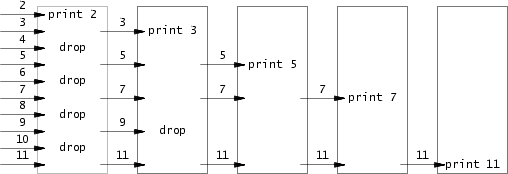
Each process handles one prime and passes only numbers not divisible by it to the next process.
The prime function prints the current prime and forks. The child recurses; the parent sends numbers not divisible by the current prime through the pipe.
| System call | Description |
|---|---|
| int pipe(int p[]) | Create a pipe, put read/write file descriptors in p[0] and p[1]. |
| int read(int fd, char *buf, int n) | Read n bytes into buf; returns number read; or 0 if end of file. |
| int close(int fd) | Release open file fd. |
| int fork() | Create a process, return child’s PID. |
#include "kernel/types.h"
#include "kernel/stat.h"
#include "user/user.h"

void primes(int) __attribute__((noreturn));

void primes(int fd)
{
    int p, n;   // Keep these local so each recursive call has independent pipe descriptors.
    int p_to_c[2];      // Static descriptors would be shared, causing incorrect closes and blocked processes.
    pipe(p_to_c);

    if (read(fd, &p, 4) == 0) {
        close(fd);
        exit(0);
    }

    fprintf(1, "prime %d\n", p);

    if (fork() == 0) {
        close(p_to_c[1]);
        close(fd);
        primes(p_to_c[0]);
    } else {
        close(p_to_c[0]);
        while (read(fd, &n, 4) != 0) {
            if (n % p != 0) {
                write(p_to_c[1], &n, 4);
            }
        }
        close(p_to_c[1]);
        close(fd);
        wait(0);
    }
    exit(0);
}

int main(int argc, char* argv[])
{
    int p_to_c[2];
    pipe(p_to_c);
    if (fork() == 0) {
        close(p_to_c[1]);
        primes(p_to_c[0]);
    } else {
        close(p_to_c[0]);
        for (int i = 2; i <= 280; i++) {
            write(p_to_c[1], &i, 4);
        }
        close(p_to_c[1]);
        wait(0);
    }
    exit(0);
}
180 UPROGS=\
...
191     $U/_primes\
Build and test.
$ ./grade-lab-util primes
make: 'kernel/kernel' is up to date.
== Test primes == primes: OK (1.5s)
find
Find all files with a given name in a directory tree.
The implementation is based on user/ls.c.
| System call | Description |
|---|---|
| int open(char *file, int flags) | Open a file; flags indicate read/write; returns an fd (file descriptor). |
| int fstat(int fd, struct stat *st) | Place info about an open file into *st. |
| int read(int fd, char *buf, int n) | Read n bytes into buf; returns number read; or 0 if end of file. |
// find.c
#include "kernel/types.h"
#include "kernel/stat.h"
#include "user/user.h"
#include "kernel/fs.h"      // directory-entry structure
#include "kernel/fcntl.h"   // flags for open()

void find(char* path, char* target)
{
    char buf[512], *p;  // buf stores the path; p manipulates the string
    int fd;             // file descriptor
    struct dirent de;   // directory entry
    struct stat st;     // file status

    if ((fd = open(path, O_RDONLY)) < 0) {      // open path read-only and get a descriptor
        fprintf(2, "find: cannot open %s\n", path);
        return;
    }

    if (fstat(fd, &st) < 0) {   // write file status into st
        fprintf(2, "find: cannot stat %s\n", path);
        close(fd);
        return;
    }

    while (read(fd, &de, sizeof(de)) == sizeof(de)) {   // read each directory entry
        if (strlen(path) + 1 + DIRSIZ + 1 > sizeof buf) {
            // Check that buf can hold the complete path.
            // strlen(path): length of the current path.
            // + 1: room for the / separator.
            // + DIRSIZ: maximum length of de.name.
            // + 1: room for the terminating \0.
            printf("find: path too long\n");
            break;
        }

        if (de.inum == 0)
            continue;

        strcpy(buf, path);
        p = buf + strlen(buf);
        *p++ = '/';
        memmove(p, de.name, DIRSIZ);

        // Copy de.name into buf immediately after /.
        // Use memmove because the fixed-size de.name array may not end in \0.
        p[DIRSIZ] = 0;

        if (stat(buf, &st) < 0) {
            printf("find: cannot stat %s\n", buf);
            continue;
        }

        if (strcmp(de.name, ".") == 0 || strcmp(de.name, "..") == 0)
            continue;
        // Do not recurse into the current or parent directory.

        if (st.type == T_DIR) {
            // Recurse when the next entry is a directory.
            find(buf, target);
        }
        else if (strcmp(de.name, target) == 0) {
            fprintf(1, "%s\n",buf);
        }
    }
}

int main(int argc, char* argv[])
{
    if (argc != 3) {
        fprintf(2, "Usage: find <path> <filename>\n");
        exit(1);
    }

    find(argv[1], argv[2]);
    exit(0);
}
xargs
How xargs works:
- Read standard input.
- Append the input as additional arguments to the specified command.
- Execute the command with those arguments.
#include "kernel/types.h"
#include "kernel/stat.h"
#include "user/user.h"

#define MAX_BUF 512

int main(int argc, char* argv[])
{
    char* new_argv[3];  // combined arguments
    char line_buf[MAX_BUF];
    int current_len = 0;

    for (int i = 1; i < argc ; i++) {
        new_argv[i - 1] = argv[i];
    }
    int initial_arg_count = argc - 1;

    while (read(0, line_buf + current_len, 1) > 0) {
        if (line_buf[current_len] == '\n') {    // execute when a newline is reached
            line_buf[current_len] = '\0';
            new_argv[initial_arg_count] = line_buf;
            new_argv[initial_arg_count + 1] = 0;

            if (fork() == 0) {
                exec(new_argv[0], new_argv);    // execute the requested command
                fprintf(2, "xargs: exec failed\n");
                exit(1);
            } else {
                wait(0);
                current_len = 0;
            }
        } else if (current_len < MAX_BUF - 1) {
            current_len++;
        } else {
            fprintf(2, "xargs: line too long, truncated\n");
        }
    }

    if (current_len > 0) {
        line_buf[current_len] = '\0';
        new_argv[initial_arg_count] = line_buf;
        new_argv[initial_arg_count + 1] = 0;

        if (fork() == 0) {
            exec(new_argv[0], new_argv);
            fprintf(2, "xargs: exec failed\n");
            exit(1);
        } else {
            wait(0);
        }
    }

    exit(0);
}
lab1 grade
$ make grade
== Test sleep, no arguments ==
$ make qemu-gdb
sleep, no arguments: OK (2.4s)
== Test sleep, returns ==
$ make qemu-gdb
sleep, returns: OK (0.6s)
== Test sleep, makes syscall ==
$ make qemu-gdb
sleep, makes syscall: OK (1.0s)
== Test pingpong ==
$ make qemu-gdb
pingpong: OK (0.9s)
== Test primes ==
$ make qemu-gdb
primes: OK (1.5s)
== Test find, in current directory ==
$ make qemu-gdb
find, in current directory: OK (0.8s)
== Test find, in sub-directory ==
$ make qemu-gdb
find, in sub-directory: OK (1.2s)
== Test find, recursive ==
$ make qemu-gdb
find, recursive: OK (0.8s)
== Test xargs ==
$ make qemu-gdb
xargs: OK (1.6s)
== Test xargs, multi-line echo ==
$ make qemu-gdb
xargs, multi-line echo: OK (0.5s)
== Test time ==
time: OK
Score: 110/110